
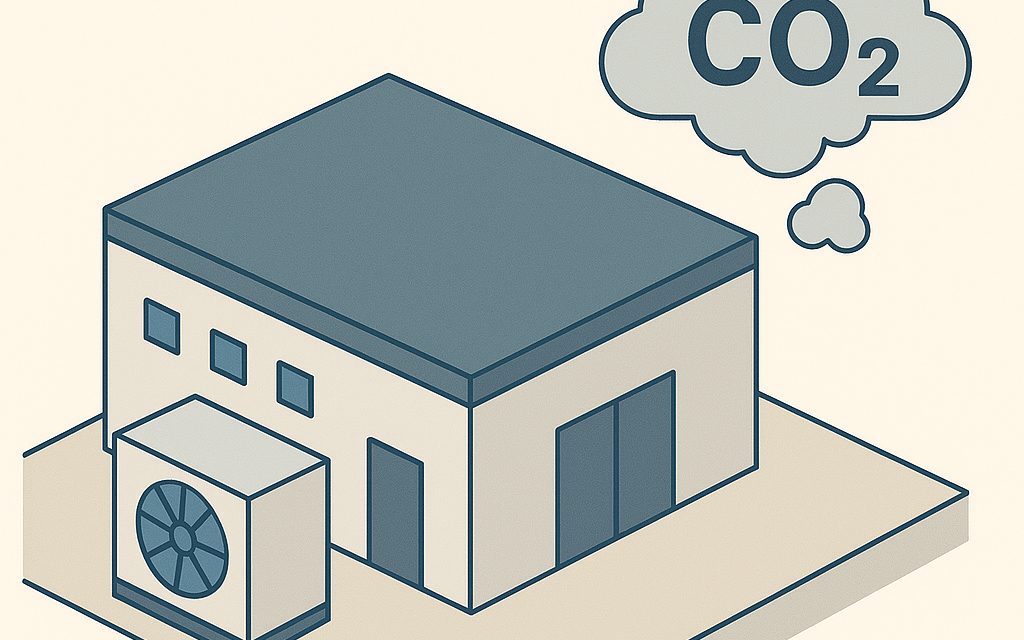
For more than a decade, data center sustainability has been defined by operational efficiency—renewable energy procurement, cooling innovation, and industry-wide efforts to drive PUE as close to 1.0 as possible. But a different kind of carbon footprint has quietly grown in importance, one that cannot be offset with solar agreements or efficiency gains. It is the carbon released long before a data center goes live, locked into its structure the moment the concrete cures and the steel bolts tighten.
This is the world of embodied carbon, and for the first time, it is becoming a central factor in how digital infrastructure is evaluated, financed, designed, and permitted. According to Nimble DC Analysts, embodied carbon accounts for more than half of a modern facility’s lifetime emissions—far overshadowing the operational footprint that PUE measures. As AI accelerates buildout velocity and megawatt deployments surge across global markets, the carbon cost of construction has become a strategic concern for hyperscalers, regulators, investors, and sustainability-focused tenants.
The industry’s challenge is clear: the materials that make data centers possible—concrete, steel, aggregates, structural framing—are some of the most carbon-intensive construction materials on earth. And reducing that footprint requires more than good intentions; it requires engineering shifts, supply-chain alignment, new procurement models, and a deeper understanding of how data centers are built.
Where the Embodied Carbon Comes From — And Why It Matters Now
The traditional metrics of sustainability have focused on energy consumption, but embodied carbon focuses on something harder to eliminate: the emissions created during material production. Data centers require thick slabs, rigid structures, high seismic performance, and long spans—all of which dramatically increase the carbon intensity of the shell.
This footprint comes primarily from two sources:
1. Concrete: The Largest Contributor
Concrete production is responsible for roughly 8% of global CO₂ emissions, making it one of the single greatest carbon emitters on the planet. In a 20–50 MW facility, thousands of cubic yards of concrete are used for:
Structural slabs and mats
Tilt-up walls
Mechanical yards
Footings, piers, and load-bearing floors
Cooling tower basins
Using low carbon concrete data center construction strategies—such as reducing clinker content or integrating slag, fly ash, and calcined clay—can reduce embodied emissions substantially, but only if integrated early in design.
2. Steel: The Structural Framework
Blast-furnace steel produces massive amounts of CO₂ due to its reliance on coke and high-temperature processing. Steel is essential for:
Long-span roof structures
Seismic bracing
Mezzanines and mechanical levels
Structural reinforcement for heavy equipment
The transition to green steel in data center construction, such as electric-arc-furnace steel with high recycled content, is reducing emissions but remains constrained by supply and lead times.
Why This Matters More Than Ever
Scope 3 emissions data center reporting is emerging as a requirement among hyperscalers, who now recognize that construction impacts must be included in climate commitments. ESG-minded tenants increasingly request carbon disclosures for the concrete shell itself—not just for operational energy.
And regulators are catching up. Markets across the U.S., EU, and APAC are implementing embodied-carbon codes that directly impact permitting. The concrete you use could soon determine whether your project secures approval.
As Nimble DC Analysts put it:
“Sustainability in data centers now begins at ground break, not at go-live.”
How Developers Can Reduce Embodied Carbon Without Compromising Performance
Reducing embodied carbon is not a procurement exercise—it is an engineering one. Structural integrity, seismic performance, load capacity, and long-term durability cannot be sacrificed. But recent innovation is making it possible to decarbonize without compromising reliability.
Low-Carbon Concrete as a Structural Standard
Modern low-carbon concrete is now viable for:
Tilt-up walls
Foundation slabs
Structural partitions
Equipment pads
These mixes often include:
Slag cement
Fly ash
Limestone calcined clay (LC3)
Recycled aggregates
Supplementary cementitious materials
However, Nimble DC Analysts warn that low-carbon mixes can alter curing time, early-strength gain, and moisture tolerance. This requires careful schedule modeling and sometimes a re-sequencing of early-stage construction workflow. When integrated early, the impact is manageable—when introduced late, it can derail a critical path.
Fossil-Free and Recycled Steel
Steel decarbonization typically involves:
Electric-arc furnaces using renewable power
High recycled content
Low-carbon billets and slabs
This supports sustainable data center building materials goals without altering structural geometry or load calculations.
Design for Circularity
One emerging approach is circular economy data center design, where facilities are engineered for eventual disassembly and reuse. This includes:
Material passports tracking every major component
Demountable steel structures
Recyclable wall systems
Future-ready design frameworks
Circularity does not reduce embodied carbon today—but it prevents future carbon emissions by ensuring materials do not go to waste in decades to come.
Modularization as a Carbon Strategy
Prefabrication reduces embodied carbon because factories:
Use materials more precisely
Optimize steel and concrete consumption
Reduce waste and scrap
Centralize manufacturing under more efficient energy use
Modular construction therefore supports sustainability while accelerating delivery—rarely are speed and ESG so aligned.
Why Embodied Carbon Will Define the Next Generation of Data Center Development
Until recently, embodied carbon was largely invisible—rarely measured, rarely reported, and rarely discussed in industry planning sessions. That is no longer the case. Three forces are converging to make embodied carbon a central competitive factor:
1. ESG-Driven Tenant Requirements
Hyperscalers now vet developers on:
Low-carbon construction practices
Embodied carbon reduction
Scope 3 emissions data center reporting
Material traceability
The developers who cannot provide this lose bids to those who can.
2. Regulatory Pressure
Permitting jurisdictions are beginning to mandate:
Carbon-intensity limits for concrete
Documentation of steel manufacturing sources
Lifecycle-carbon modeling
Waste diversion requirements
Low-carbon design is shifting from advantage to obligation.
3. Investor Expectations
Infrastructure funds increasingly demand:
ESG-aligned construction
Transparent lifecycle modeling
Resilience against future carbon taxes or penalties
Low-carbon materials now strengthen financing terms—not weaken them.
As Nimble DC Analysts note, the winners in this space will be developers who treat embodied carbon not as an environmental checkbox, but as a strategic differentiator embedded in the design and procurement process from day one.
The next wave of data center demand—driven by AI, edge deployments, hyperscale growth, and sovereign cloud expansion—will be built under far greater scrutiny. And the companies that can demonstrate leadership in low carbon concrete data center construction, sustainable material selection, circular design, and full-scope emissions reporting will secure the most valuable tenants and the most competitive capital.
The future of sustainable digital infrastructure begins with the grey—because the concrete shell determines the true carbon cost of every megawatt that follows.
About Nimble DC
At Nimble Data Center, we design, construct, and deliver next-generation hyperscale data centers, exceeding 1 gigawatt capacity, to fuel the exponential growth of artificial intelligence. We are more than a service provider—we are an extension of your team. Our diversified and highly experienced professionals bring unmatched expertise to every project, working collaboratively with your organization to deliver innovative, reliable, and scalable data center solutions. Whether you’re building your first data center or expanding a global network, we ensure your success by prioritizing your unique needs and goals.
Gensler. (2025). Designing for Lower Carbon Concrete in Data Center Construction.
https://www.gensler.com/gri/lower-carbon-concrete-in-data-center-construction
ERM. (2025). Circular Building & Construction Supply Chains for Data Centers.
https://www.erm.com/insights/circular-building-construction-supply-chains-for-data-centers-a-strategy-to-tackle-environmental-impact/
Bloomberg Intelligence. (2024). AI Infrastructure Market Forecast.
https://www.bloomberg.com/professional/blog/artificial-intelligence-infrastructure-market-forecast/

Colin VanderSmith
Colin VanderSminth is a Seasoned Technology Executive with extensive experience in cloud infrastructure, artificial intelligence, machine learning, and high-performance computing. He specializes in architecting and deploying secure cloud solutions for US Government, Department of Defense, and Federal clients, with a focus on confidential compute. Colin has a proven track record of delivering HyperScaleData Centers for Microsoft, Google, and Oracle.