
The accelerating demands of artificial intelligence have forced the data center industry into a new era—one where speed is no longer a competitive advantage but an operational necessity. AI workloads double in intensity every 6–12 months, rack densities grow with each hardware generation, and vacancy rates in primary markets sit near zero. In this environment, timelines that once seemed acceptable—18 to 24 months for typical stick-built facilities—now feel like relics from another era. The new benchmark is emerging clearly: deliver the next gigawatt in twelve months, or fall behind.
According to Nimble DC Analysts, the market’s shift toward modular and prefabricated construction is not a design preference but a direct response to existential pressure. Hyperscalers and AI tenants are no longer planning infrastructure deployment years in advance; they are racing to deploy capital, secure power, and operationalize compute clusters in time to maintain competitive relevance. Traditional construction models, constrained by sequential scheduling, skilled labor shortages, weather impacts, and field-built integration risks, simply cannot keep up.
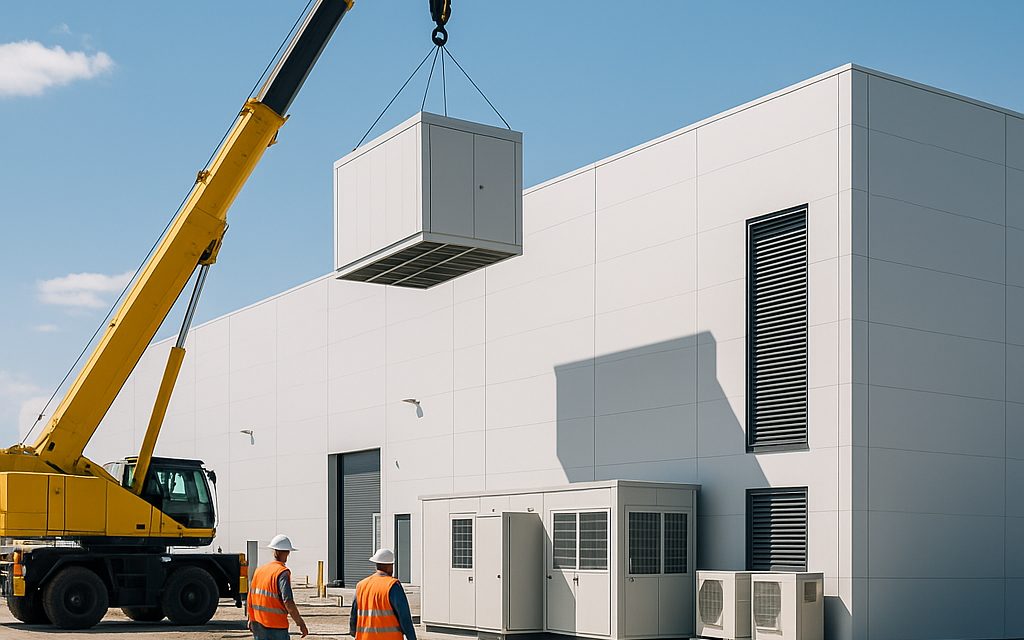
Modular construction offers a fundamental rethinking of how data centers are delivered. By building critical components—power skids, electrical rooms, cooling modules, IT pods, switching assemblies—in controlled factory environments, developers can shift from a linear model to a parallel one. While the site is being graded, modules are being assembled. While concrete cures, switchgear is being wired. While steel is erected, cooling plants are undergoing factory acceptance testing hundreds or thousands of miles away. The result is a development cycle that compresses by 30–50 percent, enables more predictable cost modeling, and removes several of the most problematic failure points associated with traditional builds.
Yet the real impact of modular construction cannot be understood purely through the lens of “speed.” Speed is the outcome, not the strategy. The deeper transformation lies in how modularity redesigns the entire risk profile of a project—technically, financially, operationally, and commercially.
Why Speed Became the Defining Metric of the AI Infrastructure Era
In previous generations of data center development, time-to-market mattered, but it did not dominate decision-making the way it does today. Enterprises planned migrations, hyperscalers forecasted capacity growth years ahead, and developers had predictable leasing cycles. AI has shattered that rhythm completely. GPU clusters now represent the most time-sensitive compute deployments in history. The value of a training cluster declines as the model architecture evolves; losing six months can mean losing an entire competitive generation.
This is why Nimble DC Analysts emphasize that the “velocity imperative” is fundamentally economic. When a delay of one month can translate into millions of dollars in lost revenue—or the loss of a major AI tenant—the industry’s tolerance for slow build cycles evaporates. Modular construction directly addresses this by removing the delays that most frequently plague traditional projects:
Skilled labor shortages that slow down electrical and mechanical integration
Weather impacts that disrupt concrete pours, roofing, or site prep
Field coordination failures where trades must choreograph complex installations in real-time
Late-stage commissioning problems, especially with switchgear or UPS systems assembled onsite
The industry’s shift toward modularity is a shift toward certainty—certainty of schedule, certainty of quality, and certainty of commissioning outcomes.
This certainty is what makes modularity attractive not just to operators, but also to investors. Private equity and infrastructure funds are increasingly weighting delivery predictability when evaluating project viability. In an environment of rising interest rates, each month of delay erodes project returns. A design that can consistently deliver 10–20 MW phases in under a year is inherently more financeable.
Moreover, AI tenants do not want “space”—they want power and readiness. Because most new capacity is pre-leased before buildings even top out, speed has become the most important leasing tool a developer can wield. You cannot win a tenant who needs megawatts in 12 months by offering a timeline of 24. Modular construction is not simply an upgrade in methodology; it is the only approach aligned with the timeline AI tenants now expect.
The Architecture of Modularity — Parallelization, Quality Control, and Scalable Repeatability
The power of modular construction lies in the way it breaks the traditional dependencies that have always slowed development. Instead of waiting for site milestones to complete, modular systems move the majority of a facility’s critical infrastructure into factories where specialized teams build, test, and certify the equipment under controlled conditions.
Nimble DC Analysts describe this shift as “moving complexity off the job site”—a migration of risk from unpredictable environments to predictable ones.
In practice, this means that components like:
Electrical rooms
UPS blocks
Battery cabinets
Switchgear lineups
Cooling modules
Direct-to-chip liquid cooling distribution units
IT-ready modular pods
…are assembled concurrently with site work rather than after it.
This parallelization offers several advantages that are particularly relevant in today’s market.
1. Standardization across deployments
Instead of reinventing the electrical topology for each facility, modular teams replicate proven templates. This standardization reduces engineering cost, accelerates permitting, and dramatically improves reliability. It also sets the stage for a franchised deployment model—critical for operators rolling out multiple sites per year.
2. Higher quality control
Factory acceptance testing (FAT) reduces the risk of discovering integration issues on site. Switchgear or UPS failures discovered during commissioning are among the most expensive failures in the industry. Modular FAT workflows virtually eliminate that risk.
3. Mitigation of labor instability
In many U.S. regions, particularly high-demand tech hubs, electrical and mechanical labor is scarce. Factory environments centralize this labor, ensuring more consistent availability and reducing schedule risk.
4. Better alignment with liquid cooling adoption
As liquid cooling becomes the dominant architecture for AI workloads, modular plants can incorporate CDUs, rear-door heat exchangers, and hybrid liquid-air systems directly into factory-built components. This accelerates the transition to high-density readiness.
This architecture of modularity reshapes not only construction timelines but also the way developers think about multi-phase builds. In a modular model, a 200-MW campus can be delivered in 20-MW standardized blocks, allowing operators to scale in predictable, replicable increments. Each block becomes a repeatable product—not just a project.
The Strategic Implications — How Modularity Rewrites the Economic and Competitive Landscape
Modular construction is not simply a construction technique. It is a strategic tool that reshapes how data centers compete, how they capture tenants, and how investors evaluate projects. The acceleration from 24-month builds to 12–14-month deliveries has profound implications across the entire lifecycle of a facility.
First, modularity directly influences tenant acquisition. AI companies and next-generation cloud providers are willing to commit early to operators who can guarantee capacity on compressed schedules. These tenants move at a pace that traditional development cannot match; they are not waiting years for capacity to come online. When developers can guarantee a 12-month energization window, they gain a decisive competitive edge.
Second, modularity expands developer optionality. When components are standardized and prefabricated, developers can pivot between powered shell and turnkey strategies based on market conditions, tenant demand, and capital appetite. They can begin as powered shell developers and transition into full turnkey providers—or vice versa—without fundamentally restructuring their supply chains.
Third, modularity rebalances cost structure risk. While modular components sometimes have higher upfront costs, they dramatically reduce the financial risk associated with:
Schedule delays
Late-stage commissioning failures
Cost overruns caused by field rework
Change orders triggered by trade coordination
Weather impacts
These factors make modular builds more predictable investments and more attractive to capital markets seeking reliable long-term returns.
Finally, modularity aligns seamlessly with the energy transition already underway. As microgrids, natural gas turbines, BESS systems, and fuel cells become standard components of next-generation campuses, modular construction will increasingly integrate these systems into prefabricated assemblies. Developers will be able to install energy infrastructure the same way they install electrical or cooling modules—predictably, repeatably, and at scale.
In the end, the rise of modular construction reflects a larger truth: the demands of AI have outpaced the capabilities of traditional development. The industry needed a way to build faster, reduce risk, improve quality, and deliver power to tenants whose timelines do not allow for 24-month cycles. Modular construction has emerged as the solution to that problem—not a compromise, but a superior model for the era of density, velocity, and power scarcity.
As Nimble DC Analysts consistently observe, the question is no longer whether modular construction will dominate the next generation of data center development. The question is how quickly operators will adopt it—and how far ahead the early adopters will pull as a result.
About Nimble DC
At Nimble Data Center, we design, construct, and deliver next-generation hyperscale data centers, exceeding 1 gigawatt capacity, to fuel the exponential growth of artificial intelligence. We are more than a service provider—we are an extension of your team. Our diversified and highly experienced professionals bring unmatched expertise to every project, working collaboratively with your organization to deliver innovative, reliable, and scalable data center solutions. Whether you’re building your first data center or expanding a global network, we ensure your success by prioritizing your unique needs and goals.
Bloomberg Intelligence. (2024). AI Infrastructure Market Forecast.
https://www.bloom.com/professional/blog/artificial-intelligence-infrastructure-market-forecast/
IT-Online. (2025). Shielding Data Centre Growth from the Looming Power Crunch.
https://it-online.co.za/2025/11/21/shielding-data-centre-growth-from-the-looming-power-crunch/
Uptime Institute. (2024). Global Data Center Survey.
https://uptimeinstitute.com/research/publications/2024-data-center-operations-survey

Randall Metcalf
Randall Metcalf is an Executive building today’s Mega Scale Transportation Infrastructure through the infrastructure Investment and Jobs Act. Driving Nimble’s teams to bridge the gap between Technology, Energy, and Resources to build Hyperscale Data Centers. SMB Expert, contributing to local socio-economic goals within underserved communities with infrastructure projects