
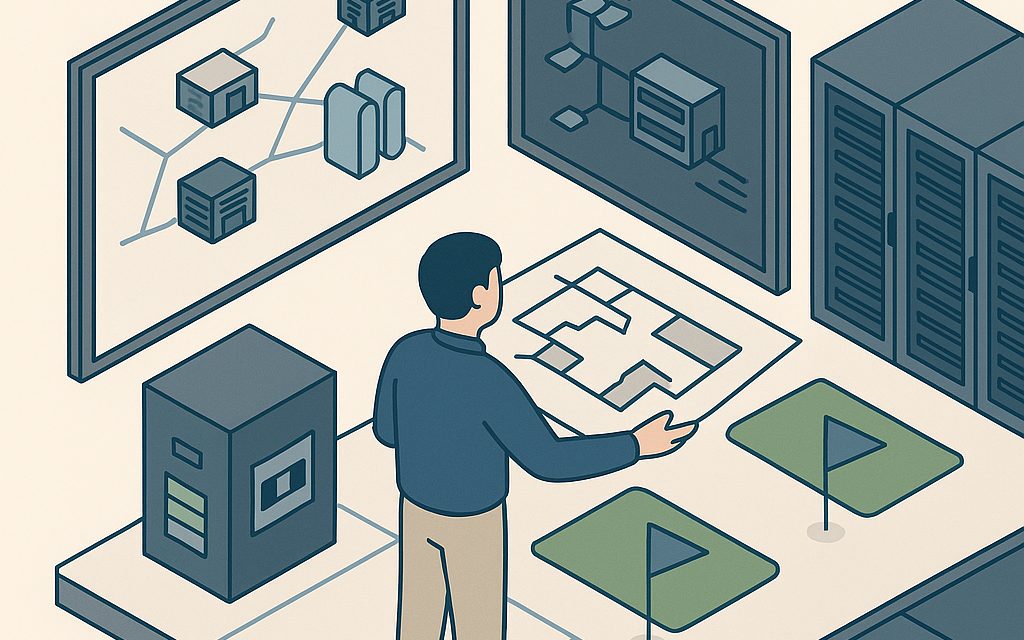
The demands of AI have pushed data center infrastructure into a period of unprecedented reinvention. For decades, utility power shaped the boundaries of what a facility could be—when it could open, how resilient it could become, and how much capacity it could support. But today’s grid, strained by explosive digital load growth and long-delayed transmission projects, no longer provides the kind of certainty the industry once relied upon. Power is arriving slower than compute demand is rising, and the mismatch is forcing developers to rethink the very foundation of how a campus receives and manages energy.
This tension has given rise to a new model that Nimble DC Analysts describe as the sovereign campus—a data center capable of operating as its own micro-utility, stabilized by a connected ecosystem of on-site generation, intelligent controls, and Battery Energy Storage Systems (BESS). In this model, the grid is no longer the single point of truth. Instead, it becomes one component of a diversified power strategy designed to withstand volatility, support high-density AI workloads, and maintain uptime regardless of external conditions.
The rise of AI has accelerated this transition dramatically. Modern GPU clusters generate erratic, high-intensity power profiles that swing sharply during training cycles, creating electrical noise and load variability that many regional grids were never engineered to absorb. These swings, repeated thousands of times per second, destabilize local circuits and stress upstream transmission systems. BESS has emerged as the indispensable solution to this challenge—not simply as a backup device, but as a real-time stabilizer that absorbs spikes and smooths demand patterns. In many ways, batteries have become the shock absorbers of the AI era.
How AI’s Power Profile Changed the Architecture of the Data Center
AI workloads did not just increase the amount of power required—they changed the shape of power consumption itself. Traditional compute produced predictable baseload draw, allowing utilities to plan around relatively consistent demand. But large-scale GPU clusters behave differently. Their consumption resembles the rhythm of an engine under load, surging and retreating rapidly as models iterate. These patterns introduce instability not only within a facility but across the distribution networks feeding it.
This is one reason Nimble DC Analysts note that BESS has evolved from a supplemental system into a core architectural requirement. Batteries allow the data center to present a smoother, more grid-friendly profile even when internal loads behave unpredictably. They act as a fast-response buffer, helping operators avoid utility penalties, reducing exposure to sudden outages, and maintaining the stability that AI tenants require for continuous training cycles.
Microgrids extend this stabilization philosophy to the entire campus. A microgrid can incorporate:
Fuel cells or natural gas turbines for on-site baseload generation
BESS for instantaneous response and load balancing
Solar or renewables, where available
Automated switching controls that determine when to draw from the grid or island entirely
This orchestration creates a data center that can operate independently when needed, islanding itself during grid failures, voltage disturbances, or brownouts. In high-growth markets where utility reliability is declining under the strain of AI-led demand, this independence is no longer a premium feature—it is becoming the expectation.
Another advantage of microgrids is the way they enable phased deployment. If full utility power is delayed, a sovereign-style site can still energize early phases using on-site generation and batteries. This means construction timelines are no longer hostage to interconnection queues, and commissioning can proceed on schedule even if the grid cannot yet support the full campus. For developers in congested regions such as Northern Virginia, Phoenix, and Silicon Valley, this flexibility is redefining competitive advantage.
The Economic Logic of Energy Independence
Energy sovereignty isn’t only about resiliency—it’s about economics. As AI clusters continue to push densities into the 100–200 kW per rack range, every watt becomes more valuable. Microgrids and BESS give operators new levers to optimize cost, reduce volatility, and unlock revenue streams that were never part of the traditional data center business model.
Peak shaving is one example. Utilities charge steep rates during periods of high demand. A campus with robust BESS can draw from its batteries instead, significantly reducing operating expenses. Demand response programs offer payments for offloading or supplying power back to the grid during emergencies. In some markets, microgrid-equipped data centers already participate in frequency regulation and ancillary services markets—turning energy storage into an additional revenue center.
This shift from cost-only to cost-plus-revenue operation is one of the most important economic transformations under way in digital infrastructure. As Nimble DC Analysts point out, a facility with flexible generation and storage is able to treat energy not only as a necessity, but as an asset.
These systems also dramatically reduce reliance on diesel generators. Historically, diesel was the backbone of data center resiliency, but it has become increasingly challenged by regulatory pressure, community concerns, noise restrictions, and long-term ESG requirements. With the support of BESS and microgrids, diesel generators can be used sparingly, or in some cases phased out entirely in favor of cleaner on-site generation.
Perhaps the most compelling economic advantage, however, is certainty. Developers no longer need to wait for overburdened utilities to complete substation upgrades or transmission projects. A microgrid-equipped campus can begin energizing in stages, securing early tenants, accelerating revenue, and protecting against the delays that vaporize project ROI. The utility still plays a role, but not an exclusive one.
Conclusion
Microgrids and BESS are not merely technological enhancements; they are strategic responses to the new reality of digital infrastructure. The grid is strained, AI is accelerating, and the most valuable workloads in the world now run on power profiles that traditional utility systems cannot reliably accommodate. The sovereign campus—the facility that can stabilize itself, support its own loads, and operate independently when required—is the model that best matches the demands of this era.
As Nimble DC Analysts consistently observe, energy independence is emerging as a defining competitive advantage. The data centers best positioned for the next decade will not be the ones with the largest footprint or even the fastest build cycles. They will be the ones with the highest degree of energy flexibility—the ability to draw from the grid when it is reliable, detach when it’s not, and buffer AI workloads with intelligent storage.
The future of data center power is not dependence. It’s orchestration. And the sovereign campus is leading the way.
About Nimble DC
At Nimble Data Center, we design, construct, and deliver next-generation hyperscale data centers, exceeding 1 gigawatt capacity, to fuel the exponential growth of artificial intelligence. We are more than a service provider—we are an extension of your team. Our diversified and highly experienced professionals bring unmatched expertise to every project, working collaboratively with your organization to deliver innovative, reliable, and scalable data center solutions. Whether you’re building your first data center or expanding a global network, we ensure your success by prioritizing your unique needs and goals.
Hitachi Energy. (2024). Backup Power for Data Centers of the Future: The Case for Hydrogen Fuel Cells.
https://www.hitachienergy.com/news-and-events/blogs/2024/02/backup-power-for-data-centers-of-the-future-the-case-for-hydrogen-fuel-cells
IT-Online. (2025). Shielding Data Centre Growth from the Looming Power Crunch.
https://it-online.co.za/2025/11/21/shielding-data-centre-growth-from-the-looming-power-crunch/
Uptime Institute. (2024). Global Data Center Survey.
https://uptimeinstitute.com/research/publications/2024-data-center-operations-survey

Colin VanderSmith
Colin VanderSminth is a Seasoned Technology Executive with extensive experience in cloud infrastructure, artificial intelligence, machine learning, and high-performance computing. He specializes in architecting and deploying secure cloud solutions for US Government, Department of Defense, and Federal clients, with a focus on confidential compute. Colin has a proven track record of delivering HyperScaleData Centers for Microsoft, Google, and Oracle.