
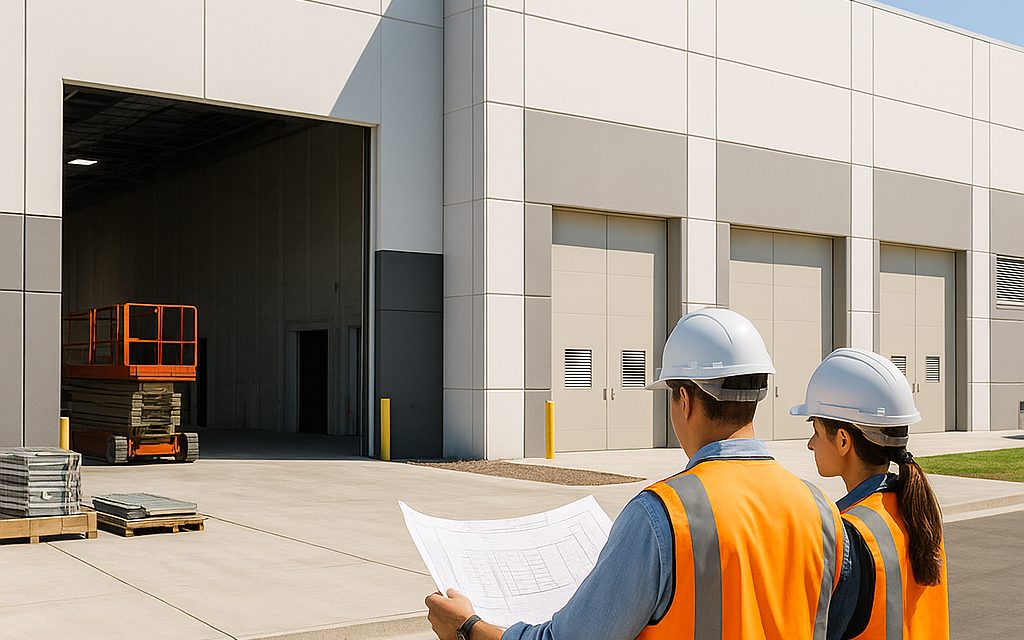
For more than a decade, the data center market operated on a familiar rhythm: developers built powered shells, hyperscalers leased them, and tenants deployed their own infrastructure inside. It was a clean division of responsibility—developers controlled the real estate and utility delivery, while tenants built out the white space according to their internal standards. The model was predictable, profitable, and well-aligned with the needs of traditional cloud platforms.
AI, however, has upended that equation. Today’s tenants are not just looking for powered shell capacity; they’re looking for fully realized, immediately deployable environments capable of supporting 50–200 kW racks and liquid-cooled AI clusters. They do not have the luxury of multi-year design and construction cycles. They are moving fast, raising capital aggressively, and requiring capacity far sooner than the shell model can typically deliver.
This shift has given rise to a new financial and development dilemma—one that Nimble DC Analysts describe as the “Shell vs. Turnkey Divide.” It is no longer enough for investors or developers to decide what to build; they must also decide for whom they are building, how fast their target tenants move, and how much of the risk and reward they are willing to take on.
The two models—powered shell and turnkey—each come with their own strengths, cost profiles, and tenant alignment. The emergence of AI “neoclouds” has not eliminated one model or the other, but it has radically changed the calculus that determines which approach yields the strongest return.
The Powered Shell — Lower Risk, but Slower to Revenue in the AI Era
Powered shells have long been the preferred investment strategy for developers who prioritize stability and predictable returns. These projects focus on delivering the building envelope, electrical distribution, mechanical backbone, and utility interconnection, while leaving the tenant responsible for completing the IT space and deploying their internal systems.
Traditionally, this model offered several advantages:
Lower development risk due to decreased complexity
Reduced CapEx relative to full fit-out
Simplified construction schedules
Appeal to hyperscalers with large internal engineering teams
Triple-net lease potential, providing steady, low-touch income
But AI tenants have dramatically different needs from traditional hyperscalers. Many emerging AI infrastructure companies do not maintain large construction departments and cannot wait 18–24 months to build out white space. These tenants are seeking ready-to-activate space, complete with liquid cooling distribution, modular electrical integration, and pre-engineered high-density pods.
According to Nimble DC Analysts, the powered shell model struggles to meet this demand. In markets with near-zero vacancy—Northern Virginia, Phoenix, Silicon Valley—the competition for immediate capacity is fierce. AI companies prioritize operators who can deliver capacity the fastest, and powered shells simply cannot match the speed of turnkey deployments when tenant construction is added into the timeline.
As a result, developers relying solely on powered shells may find themselves at a disadvantage: lower CapEx, yes—but also lower rent, slower occupancy, and limited appeal to the fastest-growing category of digital tenants.
The Turnkey Model — High Cost, High Reward, and High Velocity
Turnkey facilities are the inverse of the powered shell model: developers take full responsibility for building IT-ready space, complete with power distribution, cooling systems, containment, and even pre-installed liquid cooling infrastructure. When a tenant arrives, they can deploy their servers immediately.
What makes turnkey attractive today is not simply the convenience it offers tenants, but the way it aligns with AI-driven timelines. The most important currency in the AI market is speed to power. A tenant who must wait months or years to activate capacity loses competitive ground—and likely chooses a different operator.
Turnkey provides:
Immediate deployment for tenants
Higher rent premiums, often 2–3× shell rates
Longer lease commitments, particularly from AI operators
Greater control over design, including liquid cooling readiness
Superior pre-leasing potential, especially in constrained markets
It is no coincidence that the fastest-growing segment of data center demand is now coming from AI companies that lack massive internal construction teams. These firms are capital-rich but time-poor. They want dense power, ready-made cooling, and a thermal envelope that can support future GPU generations. Turnkey meets these needs in a way powered shells cannot.
But turnkey is not without its challenges. Higher CapEx means higher risk. Developers must accurately predict tenant needs, design for density, and build flexible environments that can serve a wide range of AI workloads. If the space sits vacant, the financial exposure is significantly greater than with powered shells.
This is why Nimble DC Analysts highlight the importance of market intelligence, tenant targeting, and early pre-leasing conversations. Turnkey is not a speculative game—it is an informed strategy that thrives when developers understand the velocity and technical requirements of their tenants.
The Strategic Divide — Choosing the Right Model for the AI Tenant Wave
At its core, the Shell vs. Turnkey dilemma is not a question of which model is “better,” but which model best aligns with the realities of AI-led demand. In high-growth markets, where power is scarce and capacity is absorbed before concrete cures, turnkey is often the more competitive approach. Its ability to capture premium tenants—and premium rents—makes it attractive for investors willing to shoulder greater upfront cost.
Powered shells, on the other hand, remain valuable in markets where hyperscalers dominate, where demand cycles are predictable, and where tenants prefer to control the internal architecture. These projects offer lower risk but may deliver slower revenue and fewer opportunities to differentiate.
The most sophisticated developers are no longer choosing one model over the other. Instead, they are designing convertible campuses—sites that can begin as powered shells and transition to turnkey, or vice versa, depending on tenant pipelines and market conditions. This hybrid approach requires supply-chain alignment, modular integration, and design flexibility, but it provides developers with the agility required in a market defined by speed and volatility.
In a world where AI is rewriting the rules of digital infrastructure, the pace of development has become just as important as the quality of the facility. As Nimble DC Analysts emphasize, the winners of the next decade will be those who master both financing models and deploy them strategically. Some markets call for shells. Others demand turnkey. The operators who understand that distinction—and act on it—will define the next era of growth.
About Nimble DC
At Nimble Data Center, we design, construct, and deliver next-generation hyperscale data centers, exceeding 1 gigawatt capacity, to fuel the exponential growth of artificial intelligence. We are more than a service provider—we are an extension of your team. Our diversified and highly experienced professionals bring unmatched expertise to every project, working collaboratively with your organization to deliver innovative, reliable, and scalable data center solutions. Whether you’re building your first data center or expanding a global network, we ensure your success by prioritizing your unique needs and goals.
Bloomberg Intelligence. (2024). AI Infrastructure Market Forecast.
https://www.bloomberg.com/professional/blog/artificial-intelligence-infrastructure-market-forecast/
Uptime Institute. (2024). Global Data Center Survey.
https://uptimeinstitute.com/research/publications/2024-data-center-operations-survey

Robert Adolph
Robert Adolph is a results-oriented Technology Executive known for building and scaling technology businesses within the data center, AI/ML/HPC, and cloud infrastructure markets. He brings extensive leadership experience as a former CPO, CRO, and Founder, driving innovation at both infrastructure startups and Dell. Robert combines deep technical expertise with a strong understanding of risk management and strategic planning, having served clients ranging from the DoD to large enterprises.