
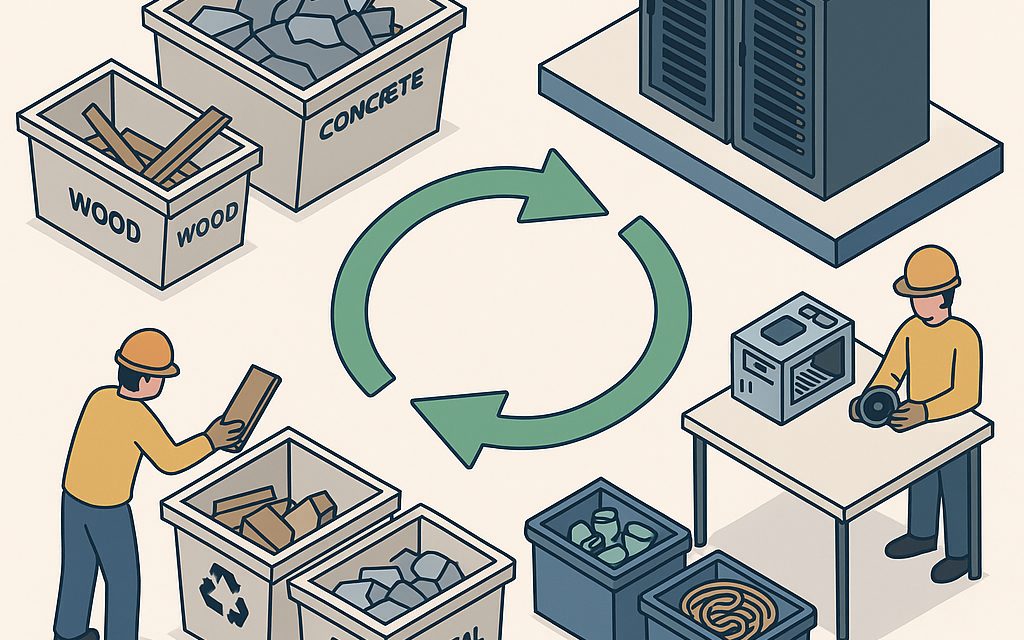
Sustainability in digital infrastructure has traditionally been framed through the lens of energy—renewable procurement, cooling efficiency, and power modeling. But a new frontier is emerging, one that looks beyond operations and into the full lifecycle of a data center’s physical footprint. As hyperscale and AI-driven construction accelerates globally, the industry is now grappling with a second sustainability challenge: the volume of material waste generated during construction, operations, and ultimately, decommissioning.
This is where the concept of the circular economy in data centers becomes transformative. Instead of the old, linear “take-make-waste” construction model, the circular approach reimagines every material—from concrete to copper to servers—as part of a regenerative loop in which waste is not discarded but monetized, reused, or reintroduced into new manufacturing cycles. According to Nimble DC Analysts, this shift will not only reduce environmental impact but unlock significant financial opportunity for operators who learn to treat waste as an asset rather than a liability.
The circular model applies to two major streams:
Construction materials (concrete, steel, gypsum, metals, cable, packaging)
IT hardware (servers, racks, power supplies, networking gear)
When managed strategically, both streams offer surprising revenue potential. And as sustainability reporting, ESG commitments, and waste regulations tighten across global markets, the data center sector is being pushed to rethink what happens to materials long after commissioning.
In this new paradigm, data centers are not just energy consumers—they are material hubs. And the operators who build circularity into their business models will shape the future of digital infrastructure.
Circularity in Construction — Turning Waste Streams Into Revenue Streams
Construction waste has historically been treated as a sunk cost. Materials leftover from demolition, site prep, or fit-out were often hauled to landfills, incinerated, or disposed of through low-value recycling streams. But with modern data centers generating tens of thousands of tons of materials during each build cycle, waste management has become both an environmental and financial opportunity.
Major projects today can achieve 90–96% construction waste diversion, using strategies that not only reduce cost but feed directly into circular supply chains.
Concrete: Crushing and Reuse
Concrete demolition and leftover pours can be crushed on-site and reused as:
Aggregate base
Fill material
Road sub-layers
Structural backfill
This reduces landfill volume and reduces the cost of purchased aggregate. For large-scale campuses, on-site crushing can save hundreds of thousands of dollars per phase.
Steel and Metal Recycling
Steel is one of the most valuable circular materials due to its high recyclability. Scrap steel, copper, and aluminum from:
Framing
Cable trays
Mechanical units
Electrical panels
Conduit and bus duct
…can be directly monetized through scrap markets. High-recycled-content steel also feeds the demand for green steel in data center construction, creating a tight circular loop.
Gypsum, Glass, and Packaging
Modern recycling programs now process:
Drywall
Glass partitions
Pallets
Plastic wrap
Cardboard reels
Equipment packaging
Sophisticated diversion programs can turn what was once landfill waste into measurable financial recovery.
Material Passports and Digital Twins
One of the most powerful concepts emerging in circular data center construction is the use of material passports, which catalog the materials used in a facility. This enables operators to:
Track recyclable components
Forecast deconstruction value
Reduce Scope 3 emissions during reporting
Support future circular economy data center design
Digital twins extend this further by mapping materials at the component level, turning buildings into long-term material banks.
As Nimble DC Analysts note, the integration of circularity into construction is rapidly shifting from a sustainability premium to a baseline expectation—especially for hyperscalers and ESG-driven tenants.
The Hardware Loop — How IT Equipment Becomes a Monetizable Asset
If construction waste is the first half of the circular model, IT hardware is the second—and perhaps the more financially compelling. Data center servers, networking gear, and storage arrays reach end-of-life rapidly due to technological obsolescence, not mechanical failure. This creates a rare category of “high-value waste” in which equipment still contains recoverable metals, reusable components, and refurbishable parts.
Refurbish, Resell, Repeat
Many hyperscalers now follow a “repair-first, reuse-second” approach that focuses on:
Component-level repair
Refurbished server deployment
Internal redeployment across different data hall tiers
Resale into secondary markets
This reduces waste while generating new revenue streams.
Urban Mining and Precious Metal Recovery
End-of-life servers contain significant amounts of:
Gold
Palladium
Copper
Silver
Rare earth elements
Server e-waste monetization strategies can extract these materials through specialized recycling partners. This makes decommissioned hardware not a disposal cost but a revenue generator.
Circular Rack and Component Design
Manufacturers are beginning to design:
Modular power supplies
Easily removable fans and boards
Snap-in repairable components
Racks with standardized mounting patterns
These innovations extend lifecycle and reduce Scope 3 emissions associated with hardware refresh cycles.
Regulatory Pressure to Reduce E-Waste
Regions worldwide are tightening e-waste disposal laws. Circular hardware strategies ensure:
Compliance with hazardous waste standards
Reduced landfill impact
Lower carbon footprint
Improved ESG reporting metrics
In the future, regulations may require operators to meet specific recycling or reuse thresholds—meaning circularity will no longer be optional.
The Circular Data Center as Competitive Advantage
The industry is moving into a phase where sustainability is a factor of economic competition. Companies are no longer adopting circular strategies solely because they want to be responsible—they are doing so because it enhances:
Operational efficiency
Material lifecycle value
Tenant appeal, especially among hyperscalers
Compliance readiness
Investor confidence
Brand differentiation
Circularity is becoming a clear sign of operational maturity.
Nimble DC Analysts emphasize three core benefits:
1. Reduced Scope 3 Emissions
Scope 3 reporting is now expected by leading cloud and AI companies. Circular programs directly reduce emissions associated with:
Material extraction
Manufacturing
Waste hauling
End-of-life disposal
2. Lower Total Cost of Ownership
Circular systems reduce:
Construction waste hauling fees
Raw material procurement costs
IT equipment replacement costs
Environmental compliance expenses
3. Residual Value from Decommissioning
A well-designed circular facility has measurable end-of-life asset value. Materials extracted during decommissioning can be:
Sold
Recycled
Reused in new builds
This shifts the financial model of decommissioning from “cost center” to “recovery center.”
As AI-driven expansion continues worldwide, the operators who master circularity will not only reduce environmental impact—they will monetize sustainability itself.
About Nimble DC
At Nimble Data Center, we design, construct, and deliver next-generation hyperscale data centers, exceeding 1 gigawatt capacity, to fuel the exponential growth of artificial intelligence. We are more than a service provider—we are an extension of your team. Our diversified and highly experienced professionals bring unmatched expertise to every project, working collaboratively with your organization to deliver innovative, reliable, and scalable data center solutions. Whether you’re building your first data center or expanding a global network, we ensure your success by prioritizing your unique needs and goals.
ERM. (2025). Circular Building & Construction Supply Chains for Data Centers.
https://www.erm.com/insights/circular-building-construction-supply-chains-for-data-centers-a-strategy-to-tackle-environmental-impact/
Uptime Institute. (2024). Global Data Center Survey.
https://uptimeinstitute.com/research/publications/2024-data-center-operations-survey
Bloomberg Intelligence. (2024). AI Infrastructure Market Forecast.
https://www.bloomberg.com/professional/blog/artificial-intelligence-infrastructure-market-forecast/

Colin VanderSmith
Colin VanderSminth is a Seasoned Technology Executive with extensive experience in cloud infrastructure, artificial intelligence, machine learning, and high-performance computing. He specializes in architecting and deploying secure cloud solutions for US Government, Department of Defense, and Federal clients, with a focus on confidential compute. Colin has a proven track record of delivering HyperScaleData Centers for Microsoft, Google, and Oracle.