
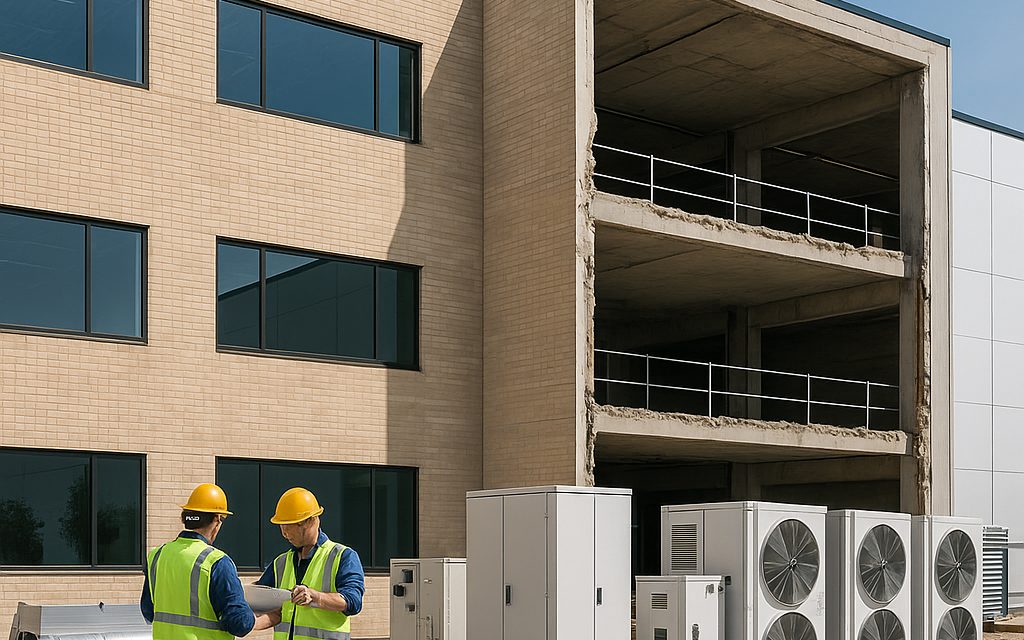
The past few years have reshaped the commercial real estate landscape in profound ways. Office buildings that once commanded premium rents and steady foot traffic are now sitting empty, victims of a remote-work revolution and shifting corporate footprints. Meanwhile, the data center industry is experiencing the opposite reality—record demand, near-zero vacancy in primary markets, and escalating land constraints that make greenfield development increasingly complex. These two opposing trajectories have converged to form one of the most intriguing opportunities in digital infrastructure today: adaptive reuse.
Turning distressed office and warehouse properties into fully functional data centers has become a strategic pathway for developers seeking to gain an advantage in competitive or power-constrained regions. But while the concept seems simple—repurpose existing buildings for new industrial use—the execution is anything but. As Nimble DC Analysts emphasize, adaptive reuse is a high-reward strategy that requires deep evaluation, rigorous engineering scrutiny, and a realistic understanding of what an existing structure can and cannot support.
Distressed real estate is not automatically digital infrastructure. And the developers who confuse opportunity with readiness often discover this the hard way. The ones who succeed do so because they understand a core truth: converting a building designed for people into one designed for compute is a complex process. But when executed well, adaptive reuse can quite literally turn distress into digital gold.
The Untapped Opportunity Hidden Inside Distressed Real Estate
The surge in office vacancies across major U.S. metros has created a unique moment. Buildings in once-premium locations can now be acquired at prices far below replacement cost. Many of these structures sit close to fiber-rich corridors, near major highways, and within dense urban catchments where low-latency edge deployments are most valuable. For developers struggling to find viable land, these properties offer something rare: location, zoning advantage, and existing utility access.
On the surface, the case seems compelling:
Location advantages provide latency benefits for AI inference, financial trading, and content delivery.
Bypassing industrial zoning battles allows projects to advance faster than greenfield competitors.
Existing electrical service can create the perception of a head start in commissioning timelines.
Redeveloping existing structures can align with ESG goals by reducing embodied carbon from demolition.
Valuation arbitrage allows developers to turn depressed real estate assets into high-value digital property.
But these advantages can obscure a deeper engineering reality: office buildings were never intended for the structural loads, cooling intensity, liquid distribution, or power density that modern data centers require. And this mismatch—between perceived opportunity and actual feasibility—is where many adaptive reuse projects falter.
Nimble DC Analysts often warn that an office building’s location or price is irrelevant if its structural bones cannot support the demands of digital infrastructure. Many conversions fail not because of vision, but because the building itself simply cannot accommodate the mechanical, electrical, and structural upgrades required.
This is why adaptive reuse must begin not with optimism, but with due diligence.
Inside the Engineering Reality of Conversion
From a distance, an office building may look like a near-ready shell. It has floors, walls, power service, elevators, and HVAC systems. But none of these systems are designed for the density or reliability required to support AI-grade compute. The transition from commercial occupancy to data center load introduces engineering challenges that are both costly and unavoidable.
Structural Loads and the Weight of Compute
Typical office spaces are engineered for 80–100 pounds per square foot of live load. Data centers often require 250–300 pounds per square foot, particularly for high-density racks, battery arrays, or liquid cooling gear. In many cases:
The floor slab must be thickened or steel reinforced.
Columns must be evaluated for load-bearing increases.
Mechanical spaces require completely new support structures.
Failing to address structural limitations is the fastest path to sunk cost.
Ceiling Height and Mechanical Pathways
Data centers depend on generous overhead clearance for:
Power busways
Liquid cooling distribution loops
Hot aisle containment
Cable trays
Fire protection systems
Office buildings with low floor-to-floor heights create severe restrictions. Even modest retrofitting often requires structural rework or a complete redesign of equipment placement.
Cooling Capacity and Liquid Distribution
Office HVAC cannot be adapted for compute cooling. Developers must integrate:
New chillers or modular cooling plants
Liquid cooling distribution units (CDUs)
Roof- or ground-mounted mechanical yards
Redundant cooling loops
High-capacity air handling (if hybrid cooling is used)
Mechanical system upgrades frequently represent the largest single cost in an adaptive reuse project.
Utility Power: The False Comfort of Existing Service
Many office buildings appear to have “ample” power—2 MW, 5 MW, or even more. But AI-era density makes these numbers almost irrelevant. A viable conversion may require:
New transformers
Upgraded utility feeds
Substation expansion
On-site generation
Microgrid integration
In many cases, the utility uplift is just as significant as a ground-up build.
Nimble DC Analysts summarize this challenge succinctly: most office buildings can host people immediately, but almost none can host compute immediately.
The path from one to the other is where conversion becomes a real engineering discipline—not a simple renovation.
When Adaptive Reuse Works — Turning Distress Into Advantage
Despite these challenges, adaptive reuse can be extraordinarily successful when the right conditions align—and when developers approach the project with technical rigor rather than pure opportunism. The key is understanding exactly what makes a conversion viable.
Successful projects typically have:
Structural integrity that supports heavier loads with minimal reinforcement
High enough floor-to-floor heights to accommodate mechanical systems
Proximity to substations capable of expansion
A layout that can accommodate large data halls without excessive demolition
Outdoor space for generators, chillers, and liquid cooling infrastructure
Straightforward permitting pathways that encourage redevelopment
Market demand for latency-sensitive or urban-edge workloads
When these factors converge, developers gain access to locations they could never otherwise secure. They can deploy capacity in constrained cities, shorten zoning timelines, tap into existing fiber networks, and deploy high-value compute in places hyperscalers have traditionally avoided.
In some markets, adaptive reuse is already emerging as the new default strategy for small-to-mid-sized deployments. In others, it serves as a bridge strategy for AI inference clusters that thrive in metro areas where greenfield development is nearly impossible.
But the defining feature of successful adaptive reuse is not the building—it’s the evaluation. Conversions excel when developers ask the right questions early, identify dealbreakers quickly, and align their technical teams before acquisition. They fail when enthusiasm outpaces engineering.
When done right, converting distressed office real estate into digital infrastructure does more than unlock new capacity. It creates value out of assets that might otherwise sit idle. It reactivates unused parcels. And it transforms the urban fabric, turning empty floors and dark buildings into high-density, future-ready compute centers.
That is what it means to convert distress into digital gold.
About Nimble DC
At Nimble Data Center, we design, construct, and deliver next-generation hyperscale data centers, exceeding 1 gigawatt capacity, to fuel the exponential growth of artificial intelligence. We are more than a service provider—we are an extension of your team. Our diversified and highly experienced professionals bring unmatched expertise to every project, working collaboratively with your organization to deliver innovative, reliable, and scalable data center solutions. Whether you’re building your first data center or expanding a global network, we ensure your success by prioritizing your unique needs and goals.
Uptime Institute. (2024). Global Data Center Survey.
https://uptimeinstitute.com/research/publications/2024-data-center-operations-survey
IT-Online. (2025). Shielding Data Centre Growth from the Looming Power Crunch.
https://it-online.co.za/2025/11/21/shielding-data-centre-growth-from-the-looming-power-crunch/
Bloomberg Intelligence. (2024). AI Infrastructure Market Forecast.
https://www.bloomberg.com/professional/blog/artificial-intelligence-infrastructure-market-forecast/

Robert Adolph
Robert Adolph is a results-oriented Technology Executive known for building and scaling technology businesses within the data center, AI/ML/HPC, and cloud infrastructure markets. He brings extensive leadership experience as a former CPO, CRO, and Founder, driving innovation at both infrastructure startups and Dell. Robert combines deep technical expertise with a strong understanding of risk management and strategic planning, having served clients ranging from the DoD to large enterprises.